
Raising children is, without a doubt, one of the most rewarding yet exhausting journeys we embark on. As parents, we often find ourselves in the thick of big feelings - the sudden meltdowns over a broken cracker, the fiery frustration of a math problem, or the heavy sadness of losing a game.
Many parents reach out to me with the same heartfelt question: “How do I actually support my child’s emotional regulation in the moment?” We read the books and understand the theory, but when the screaming starts, it’s hard to know which way to turn. We want our children to be resilient and ethical, to pause before they act, and to consider the feelings of others. But first, they need to learn how to handle the storm inside them.
Why Emotional Intelligence Matters
Research consistently shows that children with strong emotional skills perform better in school, build healthier relationships, and are less likely to engage in risky behaviors later in life. By teaching our children to identify their emotions and self-soothe, we aren't just stopping a tantrum; we are giving them a survival kit for adulthood.
This is where Positive Discipline comes in. Unlike traditional models that focus on punishment, Positive Discipline fosters a strong parent-child connection while maintaining clear boundaries. It’s about being kind and firm at the same time.
While there is a long list of effective tools in the Positive Discipline toolkit, today I want to focus on two practical, life-changing strategies: Validating Feelings and the Wheel of Choice.
Tool 1: Validate Feelings
One of the greatest gifts we can give our children is the permission to feel. Validating feelings means acknowledging their struggle without trying to fix, rescue, or talk them out of it. When we discount a child’s feelings ("It’s not a big deal" or "Don't be sad"), we unintentionally teach them that their internal compass is wrong.
How to implement it:
- Acknowledge and Describe: Instead of saying "Stop crying," try: "I can see you’re frustrated. It is indeed difficult and it can be tricky to start."
- Show Empathy: "It’s hard to lose a game. I’d feel sad too."
- Break it Down: "I know you are trying your best. Sometimes it helps to break it down into smaller parts. Is there a part that you think you could start with?"
The Lesson: We must teach children the difference between what they feel and what they do. Feelings are always okay; hitting, avoiding chores, or being disrespectful is not. Once a child feels heard, their nervous system calms down, and they become much more open to finding a solution.
Tool 2: The Wheel of Choice
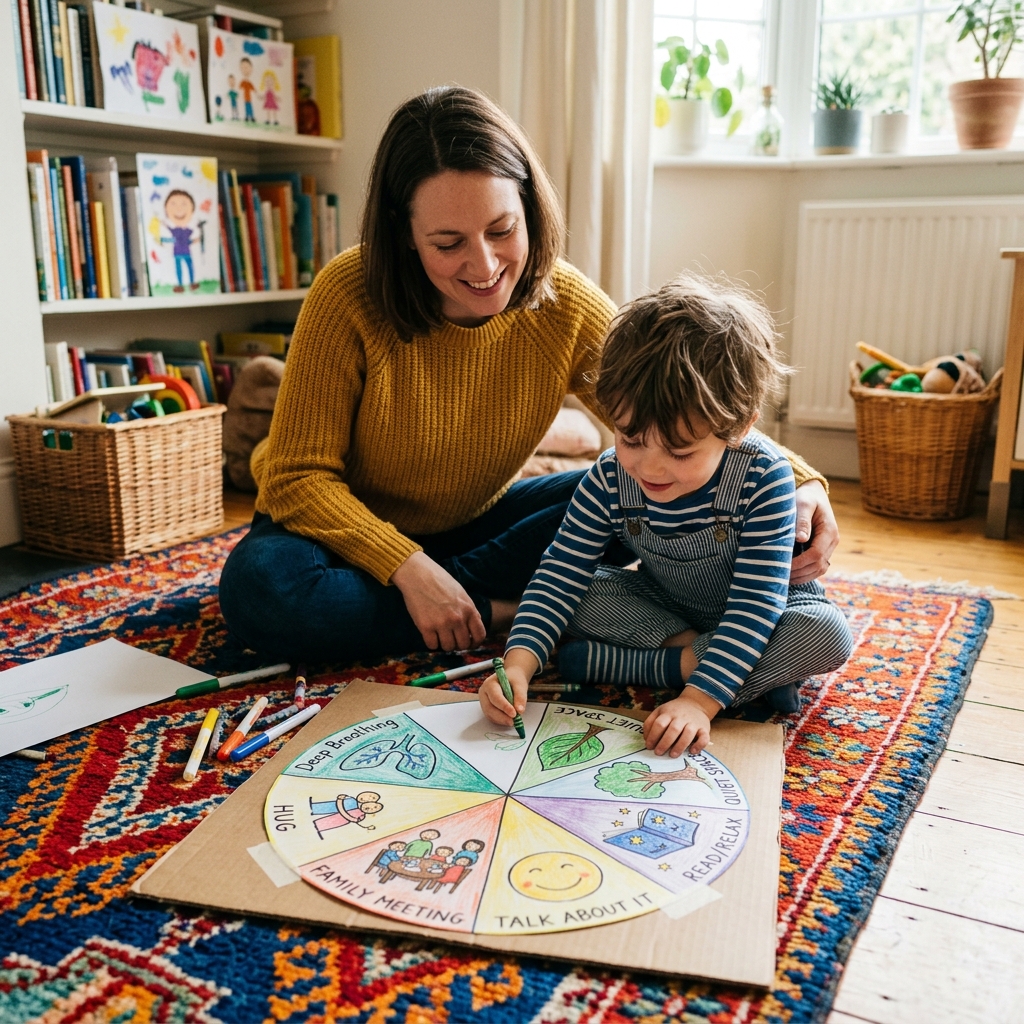
If validation is the "calm down" phase, the Wheel of Choice is the "action" phase. This tool is a visual pie chart (great for younger kids) or a brainstormed list (for older kids) that helps them focus on solutions.
The key here is involvement. The less we do as parents, the more capable our children feel. Sit down with your child during a calm moment and ask: "What are some things you can do when you are having a challenge?"
Possible Solutions to Include:
- Take deep breaths or count to ten.
- Draw/scribble or move your body.
- Ask for a hug or help from Mom/Dad.
- Put the issue on the Family Meeting Agenda.
- Hit the “reset button” and try again.
For younger children, let them draw pictures for each slice of the wheel. For older children, a simple list or a choice works best: "What would help you most right now: your brainstormed list or putting this on the family meeting agenda?" This shifts the brain to the problem-solving mode.

Final Thoughts: Building Resilience
As parents, it is painful to watch our children struggle, but we must remember that resilience is born through experience. When we allow our children to work through their feelings, trusting them to find their way back to calm, we are showing them that they are capable.
You don't have to be a perfect parent; you just need to be a supportive guide. By validating their world and giving them the tools to solve their own problems, you are building a foundation of mutual respect and cooperation that will last a lifetime. Next time the "big feelings" arrive, take a breath, validate the emotion, and eventually, spin the wheel together.